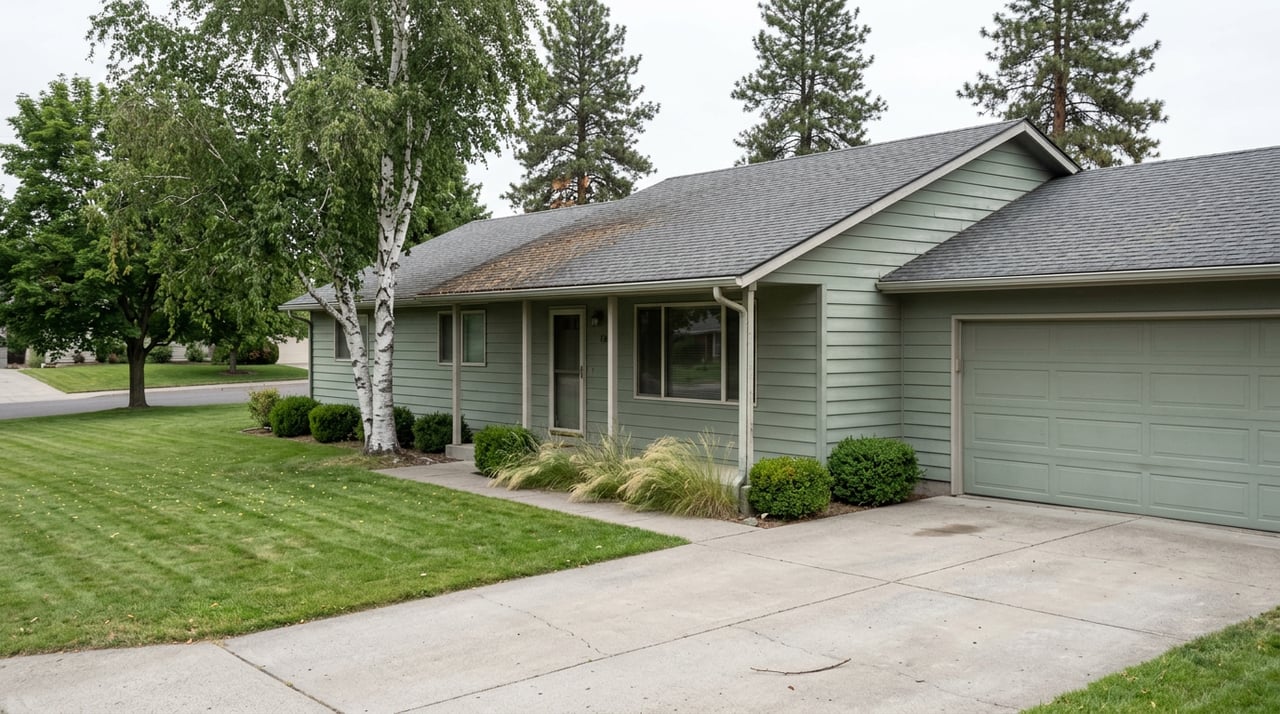
Moscow Keeps Breaking Enrollment Records. The Family Home Market Isn't Feeling It.
September 17, 2026
September 17, 2026
If you're shopping for a house in Moscow and you've read that the University of Idaho just posted its largest spring enrollment in school history, you might assume that means more competition for you. More students, more demand, more pressure on every square foot of housing in town. That's the logical read. It's also the wrong one for the market you're actually shopping in.
Moscow doesn't have one housing market. It has two, and they run on separate clocks that barely touch.
University of Idaho announced in spring 2026 that it had reached its largest spring enrollment in school history, up 2.8% from spring 2025 and marking the tenth straight semester of growth. Overall spring enrollment hit 12,213 students. Fall 2025 told the same story: 12,383 students, the largest undergraduate population the school has ever had, and the ninth consecutive semester of growth.
That is a real, sustained trend, not a one-year blip. If you're comparing Moscow to other towns on your list, this is the number that shows up in every write-up, and it's the number that makes people assume the resale market must be getting squeezed by all those incoming students needing somewhere to live.
Here's the part that write-up usually skips: the university has been absorbing almost all of that growth itself.
Rather than let enrollment pressure spill into the general rental and resale market, the University of Idaho has been building its way out of the problem on its own land. A $162 million housing project on South Hill was built with a target opening of August 2026, part of a plan that razes older, dilapidated apartment buildings (431 beds) and replaces them with 251 single-student beds and 150 married and parenting beds, along with a new commons community center. The same project funds renovations to the Wallace Residential Complex and Theophilus Tower, two of the school's existing dorms, plus updates to the Elmwood Apartments.
Before that project broke ground, the university was already leasing rooms at Moscow's Fairbridge Inn to house up to 200 overflow students, a stopgap the state board approved while the permanent housing got built. That's not a school casually keeping pace with growth. That's a school running its own parallel housing supply chain because it needs to, and because leaving that demand to spill into the private market wasn't an option it wanted to take.
This matters if you're comparing neighborhoods, because it means the enrollment story and the family-home story are largely two separate systems. One is a university building dorms and married-student apartments on its own campus footprint. The other is a collection of resale listings in neighborhoods like the Fort Russell Historic District, with its late-1800s bungalows and Tudors, or newer subdivisions like University Heights on the edge of town. Growth in the first system doesn't automatically become pressure in the second.
| Campus housing pipeline | Family resale market | |
|---|---|---|
| Driven by | Enrollment growth, university budget and bond financing | Ordinary buyer demand, local incomes, financing conditions |
| Recent supply move | $162M South Hill project targeted for an August 2026 opening | No comparable large-scale new construction reported |
| Who's competing | Undergrads, some grad students, married/parenting students | Families, downsizers, relocation buyers |
| Pace | Set by the academic calendar, August move-ins | Set by listing season, financing timelines |
If the university's building program were solving the problem completely, you wouldn't see graduate students publicly pushing back on pricing. But that's exactly what happened. In February 2026, The Argonaut, the university's student newspaper, reported that new graduate apartments under construction along Sweet Avenue were priced between $1,150 and $1,450 a month. Three graduate students, KT Turner, Richie Thaxton, and Zachary Foley, wrote publicly that the rates didn't square with what teaching assistants actually earn. Thaxton said the concern was straightforward: for some of the lowest-paid TAs on campus, more than 70% of their stipend would go straight to rent.
That's real friction, and it's worth sitting with, because it tells you something about where the pressure actually lands. It lands inside the campus housing system, among students and TAs weighing a new on-campus unit against off-campus alternatives. It does not, based on anything in the record, show up as a bidding war over a three-bedroom bungalow in Fort Russell. The people priced out of Sweet Avenue apartments aren't the same buyers competing for a family home with financing and a down payment. Those are different markets with different competitors, and the friction in one doesn't automatically transmit to the other.
So what is happening in the market a family buyer is actually shopping? The data doesn't point to a market under acute pressure from enrollment growth. It points to something closer to ordinary and, in some readings, even a little soft.
As of February 2026, Redfin scored Moscow's competitiveness at 23 out of 100, describing the market as not very competitive. Homes were selling in a median of 46 days, down from 53 days a year earlier, at a median sale price of $455,000, up 3.5% year over year.
By September 2026, the picture shifted slightly but told a similar story. Homes were spending a median of 60 days on the market, a 14% faster pace than September 2025, with a median list price of $549,000. At the same time, price per square foot had actually dipped 1% compared to a year earlier. Read those two numbers together and you get a market that's moving a bit quicker than last year without getting noticeably more expensive per foot, which is not what you'd expect if ten straight semesters of enrollment growth were spilling into the family-home market the way the headline number implies.
If you're comparing Moscow against other towns on your list, this is the useful takeaway: the enrollment story is real, but it's mostly contained to a separate supply system that the university itself is funding and building. The family-resale market, from Fort Russell's older housing stock to newer construction near University Heights, is behaving like a fairly ordinary small college-town market. It's not immune to seasonal swings, but it isn't being visibly bid up by the same growth that's filling South Hill.
A few practical implications follow from this:
Does record enrollment mean I'll be competing with investors buying up family homes to convert to rentals? Nothing in the current data supports that. The university's own $162 million project is aimed at meeting demand inside its own system, and the friction reported by graduate students in The Argonaut was about new on-campus and near-campus units, not resale housing stock.
Is Moscow's market cooling or heating up? Both signals show up depending on the month you check. Homes moved faster in September 2026 than a year earlier, but price per square foot ticked down slightly over the same period. That's a market moving without runaway price pressure, not a market accelerating in one clear direction.
Should I worry about competing with the university for the same housing stock? Only if you're shopping directly on or immediately adjacent to campus for a rental-style unit. If you're looking at a single-family home in an established neighborhood, you're shopping in a different pool of buyers than the one the university's housing office is trying to serve.
Moscow's enrollment numbers are a real story, but they're not the story that determines what you'll pay for a house in Fort Russell or University Heights this fall. If you want a read on what a specific listing or neighborhood is actually doing right now, rather than what the headline enrollment figure implies, Kiley Waldemarson can walk through it with you, house by house, and get you a free home valuation if you're weighing a move of your own.
Stay up to date on the latest real estate trends.
I am committed to guiding you every step of the way—whether you're buying a home, selling a property, or securing a mortgage. Whatever your needs, I've got you covered.
909 Bryden Ave Lewiston, ID 83501